R2.43bn spent on Parliament rebuild with Sona target in sight [PICS]
· Citizen
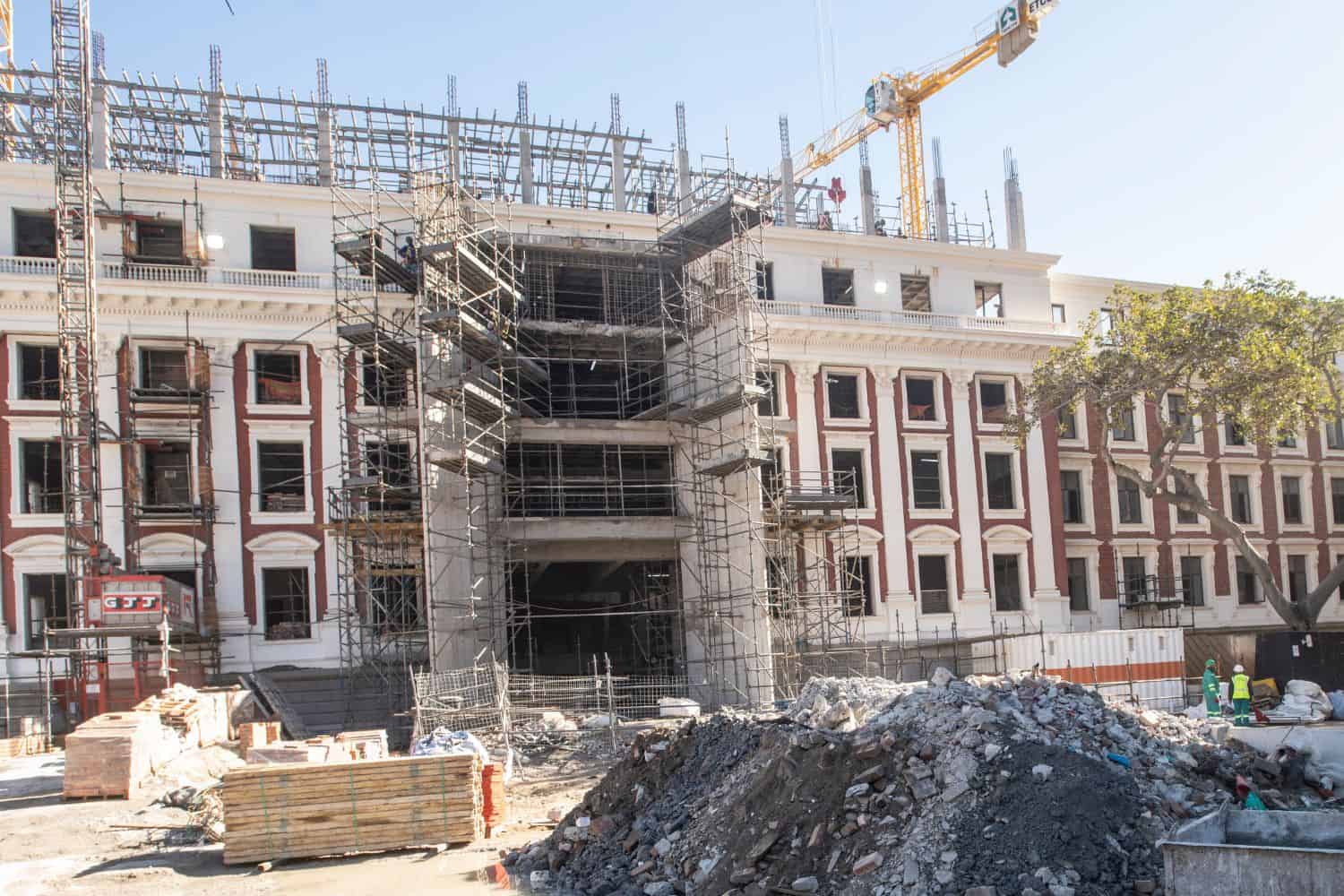
Parliament’s rebuilding and reconstruction project has surpassed R2.4 billion in spending, with officials maintaining that the National Assembly building will be ready in time to host next year’s State of the Nation Address (Sona) and Budget Speech.
Visit biznow.biz for more information.
The latest update was presented on Friday, 7 August 2026, during a meeting of the Joint Standing Committee on the Financial Management of Parliament, where the Development Bank of South Africa (DBSA) outlined progress on the multi-billion-rand project.
The rebuild follows the devastating fire of 2 January 2022, which severely damaged key sections of both the National Assembly and Old Assembly buildings.
Construction began in March 2023 but has faced delays, shifting the overall completion timeline to mid-2027.
Bigger, redesigned National Assembly takes shape
Central to the project is a significantly expanded National Assembly chamber, designed to accommodate more than double its previous capacity.
DBSA group executive for infrastructure delivery Chuene Ramphele revealed that the chamber will now seat 1 172 people, up from about 400 to 500 previously.
The main floor will host 501 MPs and 98 VIPs, while two gallery sections will each hold 300 seats.
Ramphele told the committee foundational structural work – particularly underground – proved to be one of the most complex aspects of the rebuild.
“That was the most fundamental and challenging thing that we needed to deal with. Many of you would realise that there is a stream that runs under Parliament,” he said on Friday.
Addressing underground water flow and ensuring structural integrity caused a five-month delay in the construction timeline.
The amphitheatre inside Parliament in Cape Town on 7 August 2026. Picture: Images/Brenton GeachDespite setbacks, significant progress has been made on the building’s core structure.
The main structural envelope of the National Assembly is now nearing completion at 76%, with the deadline being November 2026.
A new multifunctional amphitheatre – symbolically designed with 12 columns representing South Africa’s official languages – has already been constructed, with finishing work expected by December this year.
Finishes, ICT installation and modern exterior design
Attention is now shifting to internal finishes and technological infrastructure, with ICT systems being installed alongside final detailing work.
“By January, we should be in a position to be fully finished in that regard because we as go the ICT services are being installed,” Ramphele said.
Externally, the National Assembly building will feature a modernised façade, including glass panels and concrete panels with African artistic inscriptions, replacing the original classical portico.
These are expected to be completed between October and December 2026.
A striking African drum-inspired architectural feature will form part of the west-facing elevation toward Table Mountain.
However, progress on this element was slowed after workers encountered a hard rock at the site resulting in a two-month delay due to blasting being prohibited.
A key addition to the rebuilt complex is a public viewing deck on the fifth floor within the drum structure, designed to enhance transparency and public engagement.
Visitors will be able to observe parliamentary proceedings from outside the chamber and listen in using earphones.
Structural work on the deck is expected to be completed by January 2027, with full access anticipated by June.
The National Assembly under construction during a site visit to Parliament in Cape Town on 7 August 2026. Picture: Images/Brenton GeachThe upper floors will also include offices, kitchens, broadcast rooms and support facilities, while a dedicated lounge for MPs will be located on the seventh floor.
Accessibility has been prioritised throughout the redesign, with universal access features and braille signage included to accommodate people with disabilities in both the National and Old Assembly buildings.
Security bottlenecks slow construction pace
Ramphele highlighted operational challenges that have affected construction progress, particularly around security protocols.
Delays in the vetting and clearance of subcontractors, as well as congestion at site entry points, have resulted in lost productivity. More than 200 workers pass through security daily at the Plein Street entrance.
These issues are being addressed in coordination with the Parliamentary Security Service (PSS) and the State Security Agency (SSA).
Sona and Budget Speech readiness
Despite the obstacles, DBSA officials insist that critical sections of the National Assembly will be functional in time for the major national events early next year.
“The first floor, second floor and third floor – which is basically where the chamber is sitting, because we’ve extended that to the third and fourth floors – will definitely be completed, including all the services and the ICT nodes. All of the surrounding bathrooms and the lifts will also be working.
“We will then be in a position to test the facility at that point in time to make sure that, when members are seated there, they are able to find a fully functional chamber.
“On the fourth floor, that’s where the seating I spoke about – the 300 seats – will be, and that will also be completed.
“On the exterior, as I said and as shown in the picture, all the windows will be installed, all glass facades and roofs will be complete, and those shading fins will also be installed,” Ramphele said.
Oversight visit to Parliament rebuilding project in Cape Town on 7 August 2026. Picture: Images/Brenton GeachHe added that final cleaning and fire compliance would be prioritised ahead of occupation.
“We are pushing on a daily basis to make sure that the milestones we set ourselves on a weekly basis are achieved.
“The most important thing is fire compliance, which will be fully in place by that time.”
Before the building can be used, the DBSA must secure a sectional completion and occupational certificate from the City of Cape Town.
“You can’t then be in the position to use it without the certificate having to be offered,” Ramphele remarked.
Old Assembly restoration focuses on long-term stability
Parallel work on the historic Old Assembly building is also progressing, with its substructure 98% complete.
The chamber has been stripped to allow for restoration, including original seating and finishes, while structural reinforcement is underway to ensure long-term durability.
“The key activities in this in the Old Assembly, which is going to really help us for this structure to sustain for the next hundred years, is basically the piling that we’re doing.
“You’ll see it that it is really anchoring this [concrete] structure, especially for seismic strengthening, because the Old Assembly was even worse, as if any movement or shaking in the ground were to happen, it was just going to really be cracking down.”
Inside the Old Assembly building in Cape Town on 7 August 2026. Picture: Images/Brenton GeachHeritage elements – including brick façades and the Parliament Street wall – will be preserved and restored, while a new link bridge will connect the Old and New Assembly buildings.
Budget holds steady as completion set for 2027
To date, R2.43 billion has been spent on the project – just over half of the total R4.68 billion budget.
Of this, approximately R1.5 billion is allocated to the Old Assembly and R2.5 billion to the National Assembly.
“In essence, we have no cost overruns at this point in time,” Ramphele stressed.
The full reconstruction project is expected to be completed by June 2027, when Parliament will officially take back the rebuilt precinct.