Memories of the Train
· The Atlantic
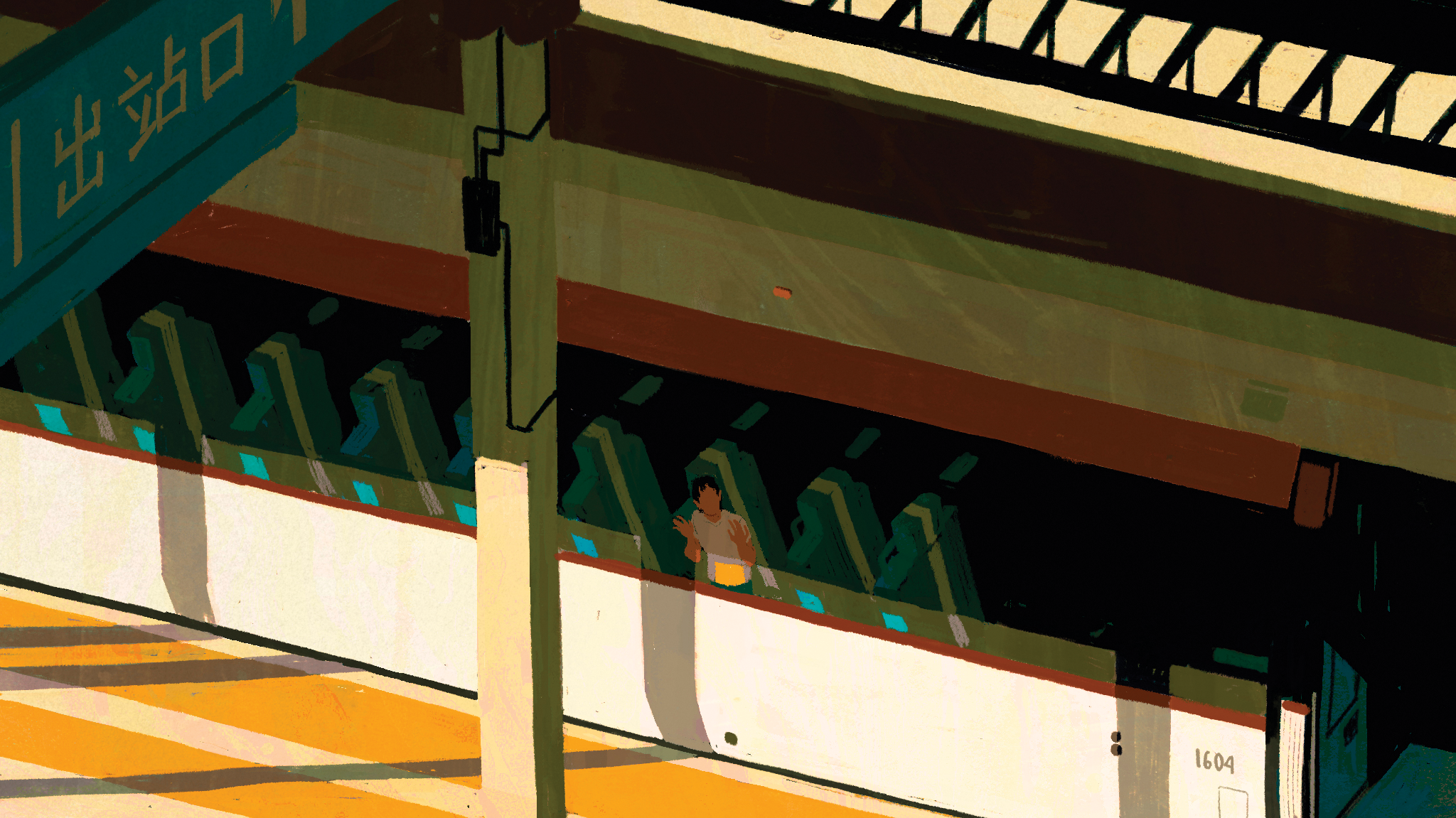
Illustrations by Katherine Lam
Visit milkshake.it.com for more information.
The train’s seats: blue with a white strip down the middle. The windows: wide, tinted green. The sun: halfway below the horizon. He was playing with the top his mother had bought from the cart lady. With each spin came flashes of rainbow light: zzz zzz zoom. The train’s seats: white with a blue strip down the middle, five per row. The windows: wide, tinted blue. A hard orange sunlight cut through the glass.
He was playing with the top his mother had bought. Next to him was his brother, Dudu. Dudu was 4. He was 9. Their mother was in the bathroom. With each spin came flashes of rainbow light: zzz zzz zoom.
The train’s seats: mostly blue and a little white, five per row. They sat in row 18. Earlier Dudu, giggling, had knocked over the top. Annoyed, he’d slapped Dudu’s hand away. Dudu had grown bored and fallen asleep. Their mother, before going to the bathroom, had told him to watch his little brother. Now the train pulled into a station, and he tried to read the name of it in the glare of the setting sun. He could recognize only two of the four characters: hill and city. Their stop was the next one, but as people got off the train, others were already standing up, reaching for their luggage. The top rolled from the tray table onto the floor, bounced, and slid under the rows in front of him. He crawled on the floor, dodging people’s shoes and thighs and suitcases, until he snatched it back into the safety of his small, warm fist. When he crawled back to his seat, Dudu was gone.
The woman: same height as his mother. Hair in a bun. Dangling earrings. She held Dudu the way their mother held him. Dudu, whose head rested on her shoulder, opened his eyes drowsily as she carried him off the train. In an instant they were swarmed by bodies on the platform. Through the window he caught a glimpse of the woman’s face, which looked ordinary, which he’d later fail to describe with any specificity to the sketch artist at the police station. Over the woman’s shoulder, Dudu’s face pinched in confusion. Inside the train, he heard a wail, sharp and alarmed, coming from his own throat. His fist pounded the glass. But the train had already begun moving.
After his brother was abducted on the train between Changsha and Guangzhou, his parents bankrupted themselves. They closed their convenience store. They camped outside the local police station. When the police moved on to other things, they spent all their money on an incompetent local detective. They spent all their time plastering ads on the telephone poles of a city that had been neither a home nor a destination. But Dudu remained gone.
A few seasons passed before they finally returned to their run-down apartment in Changsha, but it felt like years. His mother’s hair had turned white. His father’s cheeks sagged permanently, as if they were trying to run away from the rest of his face. The room he had once shared with Dudu was frighteningly quiet at night without the sound of Dudu’s soft, wet snores. Back then he believed that the walkie-talkie his father had given him for his seventh birthday had magic powers. At night, he’d take the cold block in his hands and press it against his ear, whispering, “Dudu, Dudu, can you hear me? Come back, I need you for our mission. Over.”
Silence spread through the house and wrapped everyone in their own impenetrable cocoon. He knew that his mother blamed him for what had happened, though she never said it aloud, and though he’d told the police that on the train he’d begun screaming and pounding the window right away to get the other passengers’ attention. Some mornings, in the apartment’s heavy stillness, his mother set down boiled eggs in front of him without cooling them in water. They blistered his fingers when he tried to peel them. He knew that she did it on purpose—she used to always cool them for him first. He knew that his father, though he never said it aloud, blamed his mother for what had happened. His father had once swept the hair that his mother would shed in the bathroom without complaint. Now he hardly spent time in the apartment at all. His mother’s white strands piled around the toilet like a thin layer of frost.
When his parents divorced, he chose to live with his father, because his father intended to go as far away as possible, while his mother intended on staying. She was convinced that Dudu would one day find his way back to their crumbling apartment. He followed his father to a new city, then another new city, then another new city. He toted around the shoebox that held the top and the walkie-talkie with each move. He hid the fact that he had a brother from each new friend he made, each time he introduced himself to a class.
During those years, he tried to forget about what had happened. But once in a while, he’d visit his mother and see that she continued to sit in a dark corner of their old apartment, shedding hair, shelling peanuts, waiting for Dudu to knock on the door, waiting to die. The visit would dissolve any sense of movement in his own life. His mother continued to bake cakes on Dudu’s birthday. She told him she worried that if Dudu called, she would no longer recognize his voice—surely puberty would have thickened his vocal cords, given him the tenor of a strange man.
When his father moved to the United States, he went along. He gave himself a new name in the new country: Brent, which means “hill.” Brent made new friends who believed he was an only child. He was unable to tell the first two women he loved about what had happened. The third woman, after he told her, drew his head down onto her lap and stroked his hair until dawn. He married her. They lived happily together for six years and unhappily for two, then parted ways. He made a lot of money one year and lost it all the next. Both of his parents died. On their deathbeds, both of his parents spoke of Dudu and cried.
Throughout the years, the only constant in his life was Dudu’s absence. So many of his nightmares started with the top. He blamed the top for what had happened almost as much as he blamed himself. If his mother hadn’t bought him the top, he and Dudu would have invented some game to play together. The games they once played included: “you be the soldier and I’ll be the general,” “you be the plane and I’ll be the captain,” “you be the rabbit and I’ll be the farmer,” “you be the fox and I’ll be the dog.” If they’d played a game, Dudu wouldn’t have fallen asleep. If he hadn’t been looking for the top, he wouldn’t have lost track of Dudu. If he’d been a kinder older brother, he would have let Dudu play with the top and Dudu wouldn’t have fallen asleep. If … The list went on.
“Do you find yourself consumed by all the things that could have gone a different way?” his therapist asked him. By then, he was living alone in a large brownstone in Boston after divorcing his second wife, who, despite her duplicitous nature, had been benevolent during the divorce proceedings. She’d agreed to a slightly smaller alimony on the sole condition that he start therapy. “Do you find yourself going down a rabbit hole of imagining alternative realities? Do you find yourself shaking, crying, unable to breathe normally when you follow this train of thought?”
“Yes,” he said, frowning at the word train.
The therapist opened a drawer and pressed a cold, hard fruit into his hands. “When that happens, try sucking on a lemon.”
She cut off the top of the lemon with a pair of scissors. He put his mouth on the fruit’s cool flesh. The sourness was so intense, it shot a ray of numbness all the way up his neck and into his skull. The feeling annihilated his memories for a few short, blissful moments. This was why paying extra for a human therapist made sense, he thought. The artificially intelligent ones—those bright icons bobbing on a computer screen—wouldn’t be able to hand him a lemon when he needed it.
By then, he’d tried to find his brother relentlessly for years. He’d started as soon as he’d made his first fortune. He’d paid private investigators all over the world to track down what had happened to the kidnapped boy with the crescent-moon birthmark on his left elbow. False leads had taken him everywhere: a temple of monks in the high mountains of Tibet; the burning cold of China’s northeastern countryside; a penthouse in Singapore made of sleek, dark marble; an old couple’s shack in the Australian outback (a journey that almost cost him a foot); an angry man’s courtyard in the center of Beijing; two different cities in Canada; a boat on the Mekong River. He’d been presented with men who had crescent-moon birthmarks on their left elbows and strange stories of origin, men he’d instantly determined were not his brother. Some of the prospects had been honest mistakes, while others had been clear scams for the large cash reward.
Katherine LamTwice in his life, he’d come across someone he thought was his brother. One time, he was at an ostrich farm in Cape Town with his first wife when they saw another Asian couple strolling ahead of them in an open pasture. Something about the back of the man’s head—a cowlick, an oblong skull—made Brent sprint toward him. He stopped several feet away, directly in the couple’s path. The man’s confused face looked like it could have belonged to his brother, didn’t it? There was enough resemblance in the nose, the eyes, he was almost sure. But when he whispered “Dudu?” the couple merely looked at him with alarm and scurried away. The other time, he was in the dizzyingly sunny streets of Dubai, right outside a colossal mall. He saw an Asian man passing by whose gait was so familiar that his knees went weak. Before the man could melt into the crowd, he grabbed him by the hem of his shirt. The man promptly threw off his arm and spat in his face. His elbow: bare, smooth as a porcelain plate.
When his fortune ran dry, he used what little money he had left to travel back to the city at the foot of the hill. The platform on which his little brother had disappeared had fallen into disrepair. Wildflowers gnawed at its borders. The train no longer went through here, because a new high-speed train now stopped in another part of the city. In his foreign clothes and carrying his foreign knapsack, he walked back and forth along the abandoned tracks. Over and over, he tried to recount things precisely. But the more he tried to pin down each detail—the color of the seats, the shape of the woman’s earrings—the more each detail fluttered away, like a dead butterfly emerging from its glass case, shape-shifting before his eyes.
During his year of therapy, he married for a third time. His wife was 14 years younger than he was. She possessed the perfect combination of his first wife’s intelligence, his second wife’s beauty, and a joyful optimism that neither of them had. She moved into his chilly, high-ceilinged brownstone and filled it with plants and small ceramic vases and toys for her cat. His life began to feel fuller, more peaceful. The only disagreement they had was on the topic of children. She wanted two. He wanted none. “Children are selfish, indolent little kings with no morals,” he argued. “They make their parents into servants and destroy everything.”
Aside from their impasse on this topic, they never fought and hardly ever argued. He didn’t tell her about Dudu, having learned his lesson from his prior marriages. His first wife had felt neglected when he traveled the world to chase unsubstantiated leads, leaving her behind in their cavernous house for months at a time. His second wife had resented him for spending all the money he’d made on private investigators.
So when his third wife asked about the top and the walkie-talkie in a dusty box in his closet, he replied that they belonged to the child of a friend who’d given them to him for safekeeping. On nights when he’d have nightmares about the train, and the scream rising from his throat in the dream would possess his body, and they would both shoot up in bed at the sound of his screaming, he’d tell her about a recurring dream of falling off a cliff. She’d hold him tight. “Just imagine that I’m at the bottom, ready to catch you,” she murmured.
Her optimism touched him. He sucked on lemons. He tried to forget.
Ten more years passed. His marriage began to fall apart. He began to make his next fortune. For some time, both of these things preoccupied him greatly. Though he never stopped thinking about Dudu, he found himself spending less energy on the search—a search complicated by the lies he had to tell his third wife to explain his occasional travels to obscure places. When they divorced, he grieved as he’d grieved his first two marriages, but not without a small sense of relief. Finally, he had all the freedom in the world to track down any lead that came his way.
He decided to meet up with his first wife for coffee in London, where they’d lived 20 years ago. The thing he initially noticed was that she now wore her beauty in a more intimidating way. When they were married, she’d been a shy medical-school student, but now she ran a sprawling neuroscience lab filled with technicians and Ph.D.s who, from the sound of it, snapped to attention at her every whim. Whenever she opened her mouth to speak, her dark lipstick made an authoritative ring. At first they talked nostalgically about the years they’d spent together, as if they’d absolved each other. But soon the conversation soured. She asked him if she could have her wedding dress back—it was vintage and worth a lot of money now, and had been a gift from her parents.
“Why on earth would I have it?” he asked.
“The day we moved out, you gave the handymen the wrong instructions, and they loaded the box with the dress into your moving truck.”
“All of your boxes had the red FRAGILE tape, and none of mine did. It would have been obvious if that box got mixed up with mine.”
From the wedding dress, they moved on to argue about who’d taken better care of their Rottweiler, what had happened to the stamp collection (another item lost during move-out day), why he’d thrown away the casserole her sister-in-law had made one Christmas, why she’d always complained about getting on a flight to visit his mother, who’d led such a lonely and stale existence in that run-down Changsha apartment. It had been just like this during their marriage: One of them was always telling the other that they were getting the facts wrong.
The more they argued, the more he felt a sense of relief. Recently, after divorcing his third wife, he’d been thinking about his first wife. The image that kept appearing in his mind was of the mornings they’d once spent in their tiny London flat, their legs intertwined underneath a yellow-checkered duvet as they studied the same spot on the wall where sunlight splashed onto peeling white paint. He would hold her beautiful neck and think, So this is what it’s like to have a companion in life: to look at something and know there is always someone next to you looking at the same thing. They were young back then, and malleable. There were junctures when one of them could have chosen to grow with the other instead of apart. If they had, then perhaps …
But now he settled into the safe certainty that they’d been right to leave each other. She was still the same: petty, self-centered, stubborn. She threw down her napkin, dropped a few bills on the table, and said haughtily that he ought to get checked by the memory reader. The memory reader? He set down his cup, perking up. She looked at him with pity, then an old flash of tenderness, before sashaying away.
He searched memory reader on the flight back to Boston. He read about a machine that could produce a high-resolution film from a snippet of human memory, one that captured every original visual and auditory detail. “Original is the keyword,” he saw in a paper with his first wife’s name in the byline. “What distinguishes THE MEMORY READER from its predecessors is that it is able to access the original event in perfect condition. In the human brain, every instance of a recall leads to an infinitesimal rewiring of the memory. In essence, the memory grows falser over time—colored by the subject’s emotional state and evolving subjectivity. However, THE MEMORY READER is capable of accessing the true memory and creating a replica, as if producing a livestreamed video of an event at the moment it all happened.”
Decades earlier, a team of American neuroscientists had found a way to transfer memories from one snail to another using RNA injections. They moved on to mice and rabbits and monkeys, and gradually their ambitions expanded from implanting memories to recording them. Though they’d seen substantial success along the way, the recording technology had initially failed to garner much attention—the value of accessing a false (that is, tainted) memory was low. Only in the past year had they found a way to produce the clean data of the original memory, excising the background noise of accumulated falsities with which the brain naturally swathed the original event over time. They’d tested it on minimally conscious humans (the family members of people in vegetative states were very interested in harvesting their loved one’s memories) and were just starting clinical trials on fully conscious humans.
The paper went on to describe its potential uses, such as helping Alzheimer’s patients safeguard their memories or revolutionizing the documentary-film genre, but he skipped all of that. As soon as the plane landed, he called his secretary and told him to obtain a memory reader at any cost, through legal means or not. Then he called his private investigator.
They performed the procedure on him in a rented office, in a room that was cold and bare. The investigator had explained that no hospital wanted to take on the liability of overseeing such a new operation, even though there were very few risks and no physical side effects as far as anyone could tell. After all, they would be making a copy of only a tiny memory block. The whole snippet, including the moments immediately preceding the abduction, couldn’t be more than three or four minutes long. When he woke up from the anesthesia, he felt a light whoosh in his head. But then his bare feet touched the cool linoleum floors, and he felt all right again.
The investigator made two copies of the film, one for herself and one for him. When she handed him the velvet pouch, he fingered the flash drive inside with bewilderment. “So it’s done. I can watch it now.”
“Sure you can. You can watch it, you can destroy it, you can do whatever you want with it. It’s your intellectual property—literally.” The investigator cracked a smile at her joke.
The whole way home, the flash drive felt as heavy as a brick in his pocket. He didn’t even bother removing his shoes before he charged into the living room and plugged it into his television with trembling hands. How many thousands of times had he tried to recall every detail of those four minutes, how many thousands of times had he found himself doubling back, wondering if he’d missed anything, wondering if he’d gotten something wrong? Finally he would access the original event for himself. Finally he would know the truth.
But as he sat down in front of the screen, a sense of gloom settled on him. What was the point in seeing what he had missed, in seeing the face of the woman he could never recall? It wouldn’t change the fact that 41 years and 62 days had elapsed since he’d seen his brother. It wouldn’t change all those hours of regret he’d lived. In fact—he thought back to his brief year of therapy—it would only propel him further down the dreadful rabbit hole of hypothetical thinking: what more he could have observed, what more he could have remembered. The film would give what had haunted him a more definite shape.
For a few agonizing days, he could barely sleep or eat. One moment, he’d make up his mind to watch the film. The next moment, he’d find himself on the couch, shaking, unable to bring himself to reach for the remote control. Then, one morning, the phone rang, and it was the investigator, calling much earlier than he’d expected. She’d found his brother.
He couldn’t believe it: The address where Dudu allegedly lived—on the sixth floor, unit two—was less than 60 kilometers from the apartment where they’d grown up, where their mother had stood guard for decades. After she’d died, he’d promptly sold that apartment so he would never have to think about the decaying place again. He wondered if there had been some mistake. But everything in the packet the investigator handed him made sense: the age; the birthmark; the photo ID of a man with their mother’s thick eyebrows and their father’s broad lips; and the DNA sample, which confirmed their sibling relationship.
“How did you get his DNA? Is he a criminal?” he asked her in a daze, even though he’d once paid someone to go through all the law-enforcement databases in the world that collected DNA samples from petty criminals, and no match had turned up.
“He’s not a criminal. He’s a janitor at a middle school. Married with three children. I went to the school to take a look at him myself. That’s where I got the DNA sample—we don’t need to get into the details.”
They were in his brownstone. He fell heavily onto his couch, while she perched on one of the dining-room chairs. She told him that the film of his memory had cracked the case open. “So you saw the woman’s face,” he said.
“No. You never saw her face.”
So it wasn’t his fault. He hadn’t seen her. He couldn’t have possibly described her to the sketch artist.
She explained that because she couldn’t see the woman’s face from his memory, she’d had to find a work-around. In the film, she saw the woman pass a man who sold trinkets on the platform. She’d tracked down that man, who was now old, selling secondhand phones in the new train station across the city. She’d paid him $50 to let her use the memory reader on him. In watching the film of his memory, she’d seen that the woman had handed Dudu to a man at the end of the platform. The investigator ran the snapshot of that man’s face through a criminal database and saw that it matched the face of a low-level criminal who’d been arrested for participating in a human-trafficking ring 20 years ago. The problem was that this man had been dead for five years. She had to go through a mountain of police files to find the sole member of the ring who was still alive. Then she went to Tianjin to pay him a visit. She showed him a photo of Dudu, and he said he’d never seen the boy in his entire life. But he gave her an address in a remote village in the mountains of Sichuan and told her someone there might know something.
“I went to the address and found an old blind woman living alone. When I asked if she knew a little boy with an oblong skull and a crescent-moon birthmark on his elbow, she shut the door in my face, so I knew I was on the right track. I went door-to-door, showing people Dudu’s photo, until one man, smoking on a tree stump, said, ‘Why, one summer I dragged that kid through the mud, tied to the hind legs of a horse.’ ”
She stopped and poured Brent a glass of cold water. “We don’t need to get into all the details. The important thing is that we found him. Here is the address. Here is the plane ticket.” She put the envelope into his hand and had to curl his fingers around it with her own.
The flight was the very next day. He threw clothes haphazardly into his suitcase, hailed a cab, rolled his suitcase over the smooth floors of the airport, squeezed into the plane’s narrow aisles, looked out the window as it ascended through a dense and foggy layer of clouds, and had the feeling the entire time that he was sleepwalking, that he was lost to the forceful forward motion of his body. Yet he could barely close his eyes on the long flight. The only time he did, he thought he heard Dudu’s wet snores from back when they were children. He stared wide-eyed into the plane’s darkness.
When he landed in Changsha, he realized he was no longer used to its deadly heat. Its humidity felt like a second skin. The last time he’d come was years ago, for his mother’s funeral and the sale of the apartment. When he arrived at the address the investigator had provided, he found himself staring at its whitewashed concrete walls, sweating profusely. He paced back and forth in front of the building. He walked all the way up the stairs to the sixth floor and then walked down. He repeated this three times. Each time he arrived at unit two, he couldn’t bring himself to knock. He could hear the sound of children laughing and a woman singing from behind the door and smell the scent of toasted sesame wafting through the cracks. He realized he didn’t know what to say to them. He had gotten on the plane in such a hurry, he hadn’t brought anything—no gifts, no fruits, nothing to prove he was family.
He sat on the curb, considering his options, watching sweat drip from his hairline to his knees. The apartment was at the edge of a man-made lake. Its water was turning pink from the setting sun. Whenever a hot breeze picked up, the willow by the lake shuddered. He was staring at the tree when he saw a man approaching. The man carried a backpack. He was lanky, his gait familiar and relaxed. His whistling was forlorn and friendly, and the sound of it rippled through the breeze.
First there was hesitation: They looked at each other like two spooked animals coming face-to-face in a darkening forest.
“Who are—”
“Are you—”
“You must be—”
“I am—”
“We are—”
A slew of explanations: out of sequence, incomprehensible, blubbering. An embrace, or rather a clutching of the head, the neck, the shoulders.
“I go by Brent now.”
“I go by Du Ping.”
“Can I still call you Dudu?”
“Can I still call you Older Brother?”
The first thing Brent did was scan his teary eyes up and down Dudu’s body. He was relieved to find that Dudu still had all his fingers, and that 10 dusty toes peeked from underneath his sandals. Yet he had clearly suffered. A web of crow’s-feet radiated from the corners of his eyes. Sunspots pockmarked his cheeks, no doubt from days of hard labor. A faint scar stretched from his left ear to his chin (was it from being tied to the hind legs of the horse?). His threadbare shirt had a hole at the collarbone.
“You live here,” Brent said, feeling his tongue moving clumsily around the syllables of his native language.
Dudu motioned them to sit down on a bench by the lake. A lot had happened, he explained. When he smiled, he revealed a missing bottom-front tooth. He and his wife had moved here only a few years ago. They’d been reared in the same mountainous village in a remote district of Sichuan, and it had taken them a long time to scramble out of the ditch where they’d grown up. The family that had adopted him—after he’d passed through a string of traffickers—was a peasant family that wanted a son. They’d bought him for a year’s worth of harvest. The family had been so poor. His prospects had been so slim.
Brent wanted to weep. “You’ve tasted so much bitterness.”
“Older Brother, who hasn’t tasted bitterness? Let’s not talk about such things now. It’s a happy day.”
When they had finally saved enough money to move out of the village, Dudu explained, he’d picked this town precisely because it was so close to his childhood home. “You used to take pisses from our fourth-story balcony, remember? You used to say you were watering our first-floor neighbor’s garden. Our mother used to grow those vines that curled around the railing.”
Brent nodded even though he could not remember. In general he found the memories of that apartment to be unbearable and always tried his best to forget them. They were too tangled up with the image of his mother sitting in the dark, shelling peanuts, waiting for her younger son to show up, waiting to die.
“When we first moved here, I found our old building, you know. I still remembered the address. It was not easy, because I can’t read the road signs and landmarks, but I managed by asking a lot of strangers for directions.” Here Brent couldn’t bring himself to return Dudu’s smile. He felt a swell of tears at the knowledge that his brother had remained illiterate all these years. “When I knocked on the door of the apartment I still remembered so clearly, I half-expected our mother to show up in her apron, holding a peeled banana the way she used to when she chased after us, begging us to eat so we could stop being constipated. But it was a stranger who opened the door, a young man who knew nothing about our family. It was foolish of me to think all of you wouldn’t have moved away a long time ago.”
Now Brent truly wept. He told Dudu that for decades, their mother had guarded the apartment, waiting for his return night and day. Only after her death had he sold the place. “Forgive me,” he said.
Dudu put his hand on top of Brent’s. “There’s nothing between family members that can’t be forgiven.” Though their reunion may have been delayed by a few years, Dudu reasoned, they still had decades ahead to share their lives. Besides, how could Brent have known? Life was stranger than anyone could expect.
“When you were younger, did you ever try to find us?” Brent asked.
Dudu considered this question, brow furrowed. “Older Brother, for many years I had this strange idea. How do I put it. You know, children have interesting ways of looking at the world—like my daughter, for example, who thinks that her baby sister is an alien. Who knows where these ideas come from. When I was taken away, I felt for some reason that I was taken because I wasn’t wanted. That I was bad, and the woman who took me was delivering a punishment I deserved. I thought our family was better off without me.”
Brent whispered, “How could you believe that?”
Dudu’s frown deepened. “I don’t know, Older Brother. It must have been my childish mind, creating an illusion. But I thought—I thought—I saw you looking at me through the train window, and you looked happy. I thought you didn’t try to get anyone’s attention because you wanted me to disappear from your sight forever.”
“That’s impossible! I pounded on the window. I screamed your name. I jumped up right away, I even tried to run after you, but the train started moving—”
“No doubt I was confused. Nothing during or after it made sense for a long time. Maybe I was just influenced by the unfamiliar man, who kept saying, ‘Look, kid, your family didn’t want you. They’re not even looking for you.’ Anyway, I must have believed him because twice on the journey with that unfamiliar man through that unfamiliar city, I had the chance to escape but did not. Twice he dozed off, and twice I could’ve run away, maybe eventually found my way to a police station. But all I could do was sit by his side and shiver.”
Brent wanted to weep again, but he was beginning to feel numb. Images that he’d long tried to forget rose to his mind: his father’s large, brown hands pressing wrinkled MISSING PERSON posters on countless telephone poles; his mother throwing herself at the feet of the callous police chief; his mother’s hair turning white as snow; the three of them crowding around a table in the cheap hotel where they’d stayed for months, eating ramen day after day, searching for Dudu in that strange city. He now imagined a door opening onto the scene—Dudu, led by a police officer, entering the hotel room. Dudu, who’d managed to escape from his captor, pulled into their sobbing, relieved embrace. They would’ve grown up playing together in their parents’ convenience store. They would’ve gone to school together. They would’ve always been a family. If Dudu had escaped, then …
“Older Brother, would you like to come upstairs? Meet my wife and children?” Dudu was standing up now, dusting off his pants. “They would be so happy to see you. I’ve told my wife so much about you. My oldest son reminds me of you: He likes to read and points out words on the streets I don’t know. My older daughter is always doodling in her notebook—maybe she will become an artist. My youngest one is still tiny, but people say she will be a great beauty.”
Brent could imagine what lay behind the door: a good woman, three mischievous children, a home that was clean but unbearably cramped, a laundry line sagging with fresh-smelling but tattered clothes, a tiny secondhand table where a boy who looked like Dudu did his homework and a girl who looked like Dudu drew and all of them ate rice quickly from small, cracked bowls, careful not to let a grain go to waste.
He promised Dudu he would visit soon, yes, tomorrow, definitely. For now, he needed to go back to his hotel and attend to some urgent business. Before he left, he stuffed all the American bills from his wallet into Dudu’s hands. Dudu, shocked, pushed them back. They struggled over them for a while. Eventually he shoved them into Dudu’s breast pocket, and Dudu stopped resisting. Another long-lost memory returned to Brent. As kids, they’d pranked each other by stuffing live cicadas, frogs, and spiders—and a dead sparrow, once—into each other’s shirts, in the warm places where the fabric touched skin.
Katherine LamBack at the hotel, he unzipped his suitcase. He threw aside all his clothes. From the bottom of the suitcase, he extracted a large manila folder. Inside the folder was a small plastic bag. Inside the plastic bag was a black velvet pouch. Inside the pouch was the flash drive. He’d been carrying the film with him everywhere, debating whether to watch it, waiting for the right time to watch it.
He called room service for water, ice cubes, and lemon wedges. He’d been sweating and weeping for so long that he felt dried up, like a piece of old leather left out in the sun. He immediately guzzled down two of the bottles so quickly that they flowed down his chin, washing away several dried crusts of salty tears, and soaked his shirt. By the time he was done with all that, the flash drive in his fist had turned warm, as if it contained secret mechanisms that were already ticking.
He shut every curtain and turned off every light.
In the dark, the screen burst into a fantasia of oversaturated colors:
Ding-ding-ding hello we are approaching our next station the top with its orange blue green blue rays on the tray table spinning spinning whirring zzz zzz zzz zzz zoom rainbow lights refracting off the window and the world outside is orange and inside there are white shirts red shirts green shirts shoes suitcase wheels rolling hey that’s my bag are we there yet are we sir can you help me he’s on the ground crawling the rainbow spins around a woman’s black heels ladies and gentlemen the top wedged against an empty ramen bowl discarded on the floor with a red ring of oil on its rim and when he finally takes it into his hands and pokes his head from the world of calves he sees that the seat blue with a white strip down the middle the seat where Dudu just sat a moment earlier is empty please gather your belongings the world swings wildly everything blurs until that woman falls into sight and Dudu on her shoulder is waking sleepy eyes opening a slit with confused alarm ladies and gentlemen he is looking at Dudu and Dudu is looking at him ding-ding-ding in the glass is a reflection of his own little nose and mouth.
Brent grabbed the remote control. He rewound the tape until Dudu’s drowning eyes came back into view. He let the tape play for a few seconds, then paused on his own reflection in the glass. Rewind, pause. Rewind, pause, zoom. In the reflection, the corners of his lips were turned upward. Rewind. Pause. Zoom. There was no scream. There was only a broad and unmistakable smile curling his lips like he was the destroyer of the world. There was no pounding of the window, no running after them. Zoom. Zoom. There were only his hands hanging loose by his sides, fingering his top. There was only a broad and unmistakable smile. No no no no no. The sound came from his mouth now, not the TV. He could feel the wet clay of his memory in real time, shaping, hardening, and he thought, I must stop its formation. He swiped his finger across the remote control, trying to turn off the TV, but the film continued to play behind pop-ups. He hurled the metal cup of ice cubes at the screen. There was a shower of glittering glass, a fist-size hole. Relief. He stared into the dark abyss of the hole and willed his mind into a vacuum.
For a moment he almost succeeded, but only for a moment. He heard Dudu’s voice. A punishment I deserved. You looked happy. All I could do was sit by his side and shiver. Other evil, long-forgotten images began to pour into this abyss—as a child he’d once put a grasshopper into Dudu’s mouth when it opened mid-snore; he’d slapped Dudu across the cheek, hard, the time Dudu nearly broke his walkie-talkie; he’d always picked fights with Dudu, shoving him to the ground, telling him he’d been adopted from a family of beggars, stealing his quail eggs at breakfast. The memories were coming back now. Yes, they were coming back. In the dark, he groped for a lemon wedge and stuffed it into his mouth.
This short story appears in the December 2026 print edition.