The Worst Way to Judge Your Date
· The Atlantic
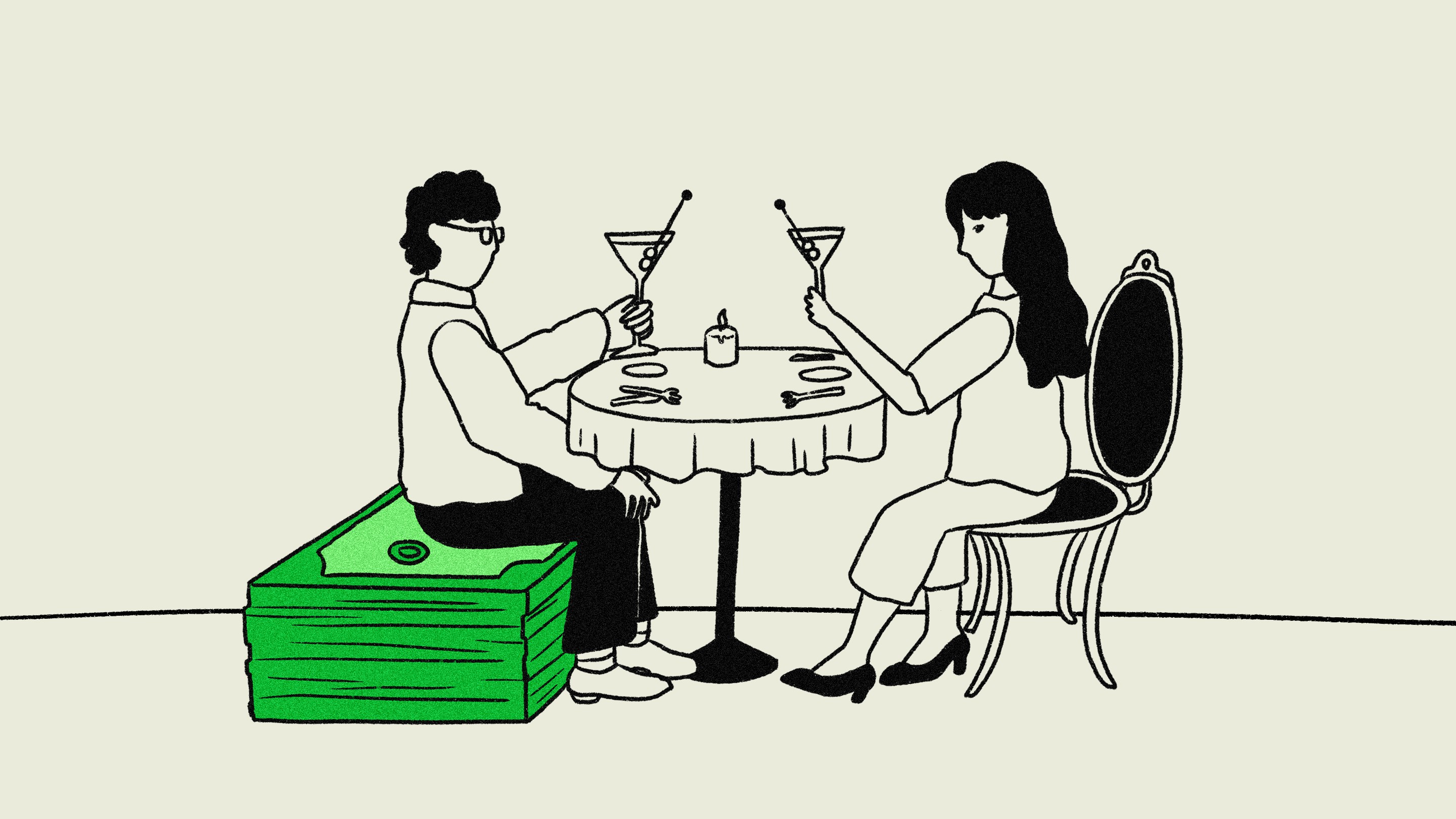
A man and woman leave a restaurant. “I had a nice time—” she begins, but he’s already off, skateboarding away with nothing more than a “Call me.” Then she receives a Venmo request: “your half.”
Out pops the actor Julia Fox, here to impart a warning. She shows a montage of how a relationship might unfold with this scruffy, nonchalant man—flashes of him playing video games in a filthy apartment, holding an umbrella over himself while she gets drenched, presenting her with a cheap engagement ring. The message is clear: If he won’t pay for your dinner now, he’ll be a stingy, unchivalrous man-child forever.
Visit tr-sport.bond for more information.
This trailer isn’t for Fox’s next film. It’s for the new “Anti 50/50 Campaign” she’s promoting with the dating site Seeking, which involves a $50,000 fund to reimburse singles who have split the check on a date (up to $50 a person). “Seeking is challenging what it sees as a decline in generosity,” the press release reads. That statement is not gender-neutral. In the company’s own survey, 75 percent of women said they prefer men to “take the lead on dates,” including planning and paying—yet 61 percent of female Zoomers said they’ve been asked to share the bill. Seeking regards this as an affront to straight women everywhere. “I’m all for women being independent,” Fox says in the release, “but that doesn’t mean we have to entertain low-effort men who think splitting a check is the height of romance. If you’re going to court somebody, COURT THEM.”
Of all the causes Fox could take up in our year 2026, this one is oddly old-fashioned. But Seeking is taking advantage of something real: The expectation that men should foot the bill, especially on the first date, is still stubbornly ubiquitous, even among women who see themselves as progressive or critical of strict gender norms. In a dating world that can feel hard and confusing, many singles are looking for explicit rules—and many straight women are looking for a man who offers care and consistency. Alas, a paid check does not a gentleman make.
[Read: Bumble moves the first move back to men]
The bill-paying convention, like it or not, has its roots in a philosophy of clear-cut gender difference: Men are born providers and leaders, whereas women are passive and dependent. For many years, this was the logic by which American society generally operated. Women had precious few career opportunities; their presumed job was to be a wife and mother. So in the early 20th century, when more women began dating in public spaces rather than having suitors visit their home, men were expected to pay. They were the ones with money to fork up.
Now, though, a far greater number of women are financially self-sufficient. In this context, the assumption that men should pay for dates seems a bit weird, and weirdly pervasive. For her 2020 book, The Mating Game: How Gender Still Shapes How We Date, the Appalachian State University sociologist Ellen Lamont interviewed college-educated young adults and found that more than two-thirds of women participants said that all of their first dates were covered by the man. Many of them would offer to split the check as a test, hoping that the man would insist on paying. One 27-year-old told Lamont that she didn’t find it important for a man to grab the first check, but “I would expect it, and then if he expected me to pay for half, or if he expected me to pay, then I’d be like, I’m out.” So it was important, then? Lamont clarified. “I guess it is,” the woman conceded. “’Cause I’d be like, man, he didn’t even pay, what a douche.”
Lamont has found that courtship norms are unusually sticky. Many people dismiss the idea of stark, inherent gender differences in other realms—they think that women are just as equipped as men to have a career, or that men should be equally involved parents. Yet at the same time, they quietly maintain that men should be the ones to ask women out, pay for dates, suggest exclusivity or commitment, and propose marriage. People are motivated by their own interests, after all; women fought for the right to vote and to enter the workforce not just for the abstract concept of equality but also because they wanted a say and a paycheck. A woman might find splitting the bill about as appealing as a man might view splitting the housework. And guidelines can be comforting, especially for a ritual as intimidating as dating. No one wants to misstep. So people tend to follow the rules—even rules they don’t fully stand behind in theory.
They rationalize, of course. Some people have told me that men should get the tab because they make more money on average. (If this was really the logic, shouldn’t the higher-earning person pay, whoever it may be?) Others—including some men I’ve spoken with—hold that the least men can do is front the bill, given that the woman otherwise tends to bring more to the table: better listening skills, empathy, social graces. The man, according to this line of thinking, is lucky to be there at all, whereas the woman has more to lose—especially in a climate of misogyny and prevalent harassment. But putting women on such a pedestal, presuming that they’re inherently soft and nurturing and pulled together, is flattening in its own way.
Many women also see willingness to pay as a sign of genuine interest: “an easy gimme,” Lamont said, particularly for young women who have recently left college hookup culture behind and are looking for courtship that feels serious and grown-up. Regardless of gender, reading someone’s feelings is difficult. And a lot of women look for tokens of dedication, she said, because they’ve been told again and again that men are commitment-phobic libertines. Something as prosaic as a credit card in a cup, when you’re scanning for green flags, can take on outsize significance.
This was true at the time of Lamont’s research, and it may be even truer now, when a lot of straight women are fed up with a perceived lack of enthusiasm from male prospects. The dating app Bumble, once known for its “women message first” policy, now allows men to initiate; when the company surveyed women, it found that many were tired of putting themselves out there and wanted men to step up—to be present, active, eager. Meanwhile, a slew of think pieces have captured a similar yearning. “Lately I have been bruised by the ambivalence of men,” the writer Jean Garnett wrote in The New York Times, recalling a man who’d canceled their date when he was feeling anxious. “Where were the men who could handle hard stuff? Like leaving the house for sex?” The headline of another Times story summed up the sentiment: “Men, Where Have You Gone? Please Come Back.”
The problem is that bill paying alone isn’t actually a good gauge of emotional investment. Many of the men Lamont interviewed told her that they’d grab the check even when they had no interest in seeing their date again. A man can also be rich, keen, and a self-involved jerk. (A 2016 study of university students in California found that, among male participants, embracing traditional courtship norms was associated with “hostile sexism” and the disavowal of feminism.) On the flip side, a man who suggests splitting the bill might be earnestly trying to foster an equitable dynamic. Or maybe he just doesn’t have the money to throw down $100 every time he takes someone out, and maybe—going out on a limb here—being broke doesn’t make someone a lazy schlub.
A ton of single people today, men and women alike, say they’re forgoing dating because it’s too expensive. The team behind Seeking understands this on some level; the company refers to “rising dating costs and growing frustration with the modern dating experience” as its raison d’être—but it seems to find that strain to be a problem for only half the population. When men see dating as cost-prohibitive, though, that’s an issue for straight women too. Where have the men gone? Perhaps home to spare their aching wallet.
[Read: The dystopia of modern singlehood]
If courtship is going to evolve beyond outdated gender expectations, the transition will not always feel smooth. Women who want new models of masculinity will need to let go of old ones—trading the comfort of paternalism for the satisfaction of being seen as a capable adult, or the convenience of covered costs for a connection between equals. And sometimes, two people will have to chuckle at the awkwardness of not knowing who initiates or pays or plans. I actually find this to be a sweet part of dating: when both people reach for their card, lock eyes, and laugh; or when one gets to show that they’re having fun by saying, “I’ll get us next time.” Eventually, you realize that, despite plenty of ambiguity, you’ve both been trading little affirmations back and forth, one person texting first, the other suggesting a location or giving a compliment. You find that uncertainty can be survived. And only by working through it together do you discover what fits—not for men and women as abstract categories, but for two distinct human beings.
When you buy a book using a link on this page, we receive a commission. Thank you for supporting The Atlantic.